Here’s part 1 of the series on belonging, which includes trying to define belonging and why it matters so much to us as humans. I didn’t actually get to cognitive biases, but hey – what’s another blog in the already 6-part series?!?
Belonging – What at least some of the research says
What we know:
- belonging is considered a fundamental human need
- belonging imbues a need to connect both personally and socially
- a lack of belonging is as toxic to human health as cardiovascular disease
Geoff Cohen (whom I discuss more below) defines belonging as “the feeling that we’re part of a larger group that values, respects, and cares for us—and to which we feel we have something to contribute” (Cohen, 2022, p. 12). He also states that “the word ‘belong’ literally means ‘to go with,’ and our species has evolved to journey through life with each other”(Cohen, 2022, p. 12). But I think my favorite definition of belonging comes from Susan Wise’s Design for belonging: How to build inclusion and collaboration in your communities. Wise states that
belonging is being accepted and invited to participate; being part of something and having the opportunity to show up as yourself. More than that, it means being able to raise issues and confront harsh truths as a full member of a community.
(Wise, 2022, p. 3)
To belong is to feel like you are so comfortable with a group that you can confront and expose ugly truths in a way that is indicative of your status as a full member of the community. Wow.
In the literature, belonging, unfortunately, is a muddy construct because different researchers define belonging differently based on their needs. Therefore finding a comprehensive systematic or scoping review of belonging (like a meta-analysis) is difficult.
But when I reviewed a sample of papers considered foundational, including several attempted systematic reviews (Fong et al., 2017; Wilson et al., 2015; Allen et al., 2018; Dost & Mazzoli Smith, 2023), I found that there are at least three types of belonging in education studied:
- institution/school belonging
- major/discipline belonging
- classroom belonging
The question is, of course, which of these three types of belonging was most important in terms of student persistence and retention? The answer seemed pretty straightforward to me – Classroom belonging.
I also reviewed a sample of papers that took a more critical view of belonging (Dewsbury, 2017; O’Hara, 2022; Killpack & Melón, 2016; Dopmeijer et al., 2022). In these analyses, counternarratives do seem to be an important method for systematically oppressed groups to feel greater belonging.
But there’s a massive caveat to only using counternarratives to increase feelings of belonging.
The caveat is that the counternarrative that we might expect to be most helpful is not always the counternarrative the student would pick. This finding harmonizes with a project I did in Organic I a few years ago. I asked students to find someone successful in the field my students had chosen to go into. This person needed to be successful in Organic Chemistry – whatever that meant to the student because I was already having issues with grades at this point. Ideally, this person would have also talked a bit (in some interview or forum) about how they were successful when the material got difficult or times got tough. I gave a list of example humans from different fields and different races, ethnicities, genders, neurodivergences, etc. to choose from if the student did not want to find their own.
My surprising finding? My two-spirit Navajo student did not pick the native nor the trans person, but they instead picked the white guy with ADHD. When I asked them to explain their choice (it was part of the assignment), they stated that their own ADHD was the aspect of their learning lives that was most difficult to overcome to be successful in Organic Chemistry. They needed to see someone who had succeeded given their same neurodivergence.
Diving into Belonging (The Book) by Geoff Cohen
And then I decided to dive into belonging as analyzed by a social psychologist – Geoff Cohen. I was prompted by this LinkedIn text by a connection through NSF, Dr. Bonnie Green:
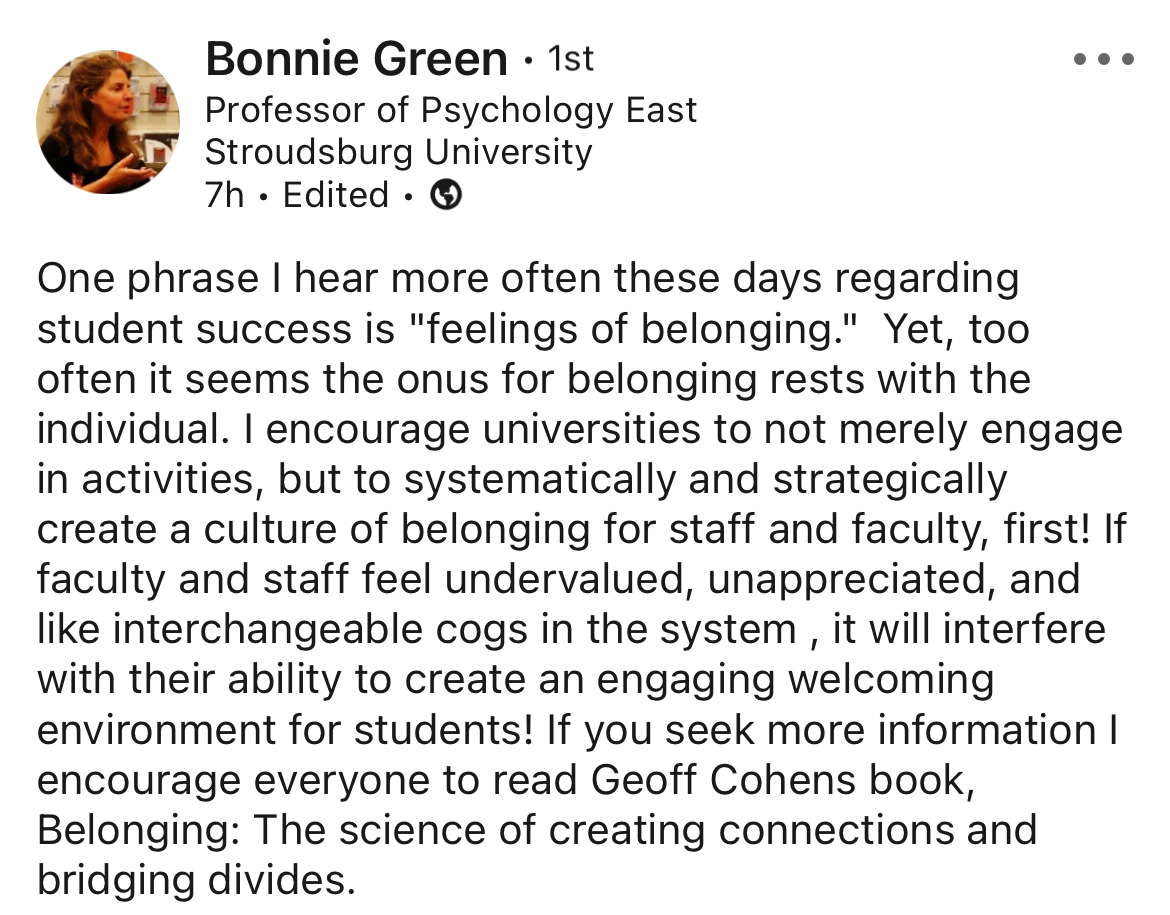
Alt text for picture: “One phrase I hear more often these days regarding student success is ‘feelings of belonging.’ Yet, too often it seems the onus for belonging rests with the individual. I encourage universities to not merely engage in activities, but to systematically and strategically create a culture of belonging for staff and faculty, first! If faculty and staff feel undervalued, unappreciated, and like interchangeable cogs in the system, it will interfere with their ability to create an engaging welcoming environment for students! If you seek more information I encourage everyone to read Geoff Cohen’s book, Belonging: The science of creating connections and bridging divides.”
There were many aspects of this book that I absolutely loved, and some that I didn’t. I mostly combined the aspects I loved learning about with some information I knew in this powerpoint presentation.
This might be my favorite slide:

Alt text for picture: “A substantial body of research has established that students who report a strong sense of belonging tend to be more motivated to learn, perform better academically, have better rates of attendance, engage in less misconduct and fewer health-threatening behaviors, and have higher self-esteem and better mental health.” (Cohen, 2022, p. 159)
So, yeah – belonging matters.
A Quick Foray (OH SQUIRREL!) into Academic Tenacity
That substantial body of research stated in the slide above includes Cohen, G. L., & Garcia, J. (2008), Dweck, C. S., Walton, G. M., & Cohen, G. L. (2014), Resnick et al. (1997), and Strayhorn, T. L. (2018). While all of this research was fascinating, I was most fascinated by the white paper on Academic Tenacity by Carol Dweck, Greg Walton, and Geoff Cohen, which can be found here. Academic tenacity is defined as the non-cognitive factors, including the mindsets and skills, that promote long-term learning and achievement. Key characteristics and behaviors of academically tenacious students include (Dweck, Walton, & Cohen, 2014, p. 4):
- belong academically and socially
- see school as relevant to their future
- work hard and can postpone immediate pleasures
- not derailed by intellectual or social difficulties
- seek out challenges
- remain engaged over the long haul
The work on academic tenacity seeks to explain why “two students with equal academic abilities can respond in remarkably different ways to frustration, with one relishing the opportunity to learn and the other becoming demoralized and giving up” (Dweck et. al, 2014, p. 5). Learning about academic tenacity was both completely revelatory in some ways and totally not in others, as I have done quite a lot of work on self-efficacy (see my video playlist on Bandura’s work here), including growth mindset; self-regulation, including metacognition; and belonging.
I’m visualizing these three constructs overlapping as a Venn diagram…
Academic Tenacity is:

With self-efficacy as the belief that one *can succeed* in certain tasks or specific contexts and self-regulation as the ability to control one’s behavior, feelings, and reactions to what’s happening around them. Metacognition, the awareness and understanding of one’s own thoughts and learning processes, fits within self-regulatory behaviors.
I need to think about this A LOT more. But for the moment, it seems like an interesting thread to pull.
A Quick Analysis of Belonging (the book) and Some Extra Info
Cohen’s Belonging was a tough book to get through, as the emphasis on providing research evidence for every claim was almost unreasonable. I would not recommend the book to folks who are not regularly steeped in reading research. It also overemphasizes RCTs (randomized controlled trials, which I’ve written about pretty extensively here) and evolutionary psychology (in juxtaposition to sociology).
However, it was an excellent book that I learned a lot from. I think Geoff distills the major points of the book in a more digestible fashion to a broader audience in his two YouTube videos here (shorter, like 15 minutes):
and here (longer, like an hour):
There’s a conversation with Cohen here, moderated by the Library of Congress, which adds nuance to – and interesting tidbits from – the book:
Concluding thoughts (For right this moment)
Needless to say, belonging is a HUGE concept that every human has experienced at times and not experienced at others throughout their lives. Therefore, everyone has a hot take on what it is, and what it isn’t. Having done some initial research, I can say three things about belonging: 1) it is such an important part of our lives that not feeling belonging registers as pain in terms of brain activity; 2) measuring belonging is probably not possible, so we measure perceptions of belonging instead; and 3) one could spend a lifetime researching belonging and never become an expert in all of its facets.
It’s been fun, though, to jump down the rabbit hole on belonging for awhile. Let me know your thoughts, resources, etc. if you’re willing to share in the comments below.
Beginning Belonging Resource List
Allen, K., Kern, M. L., Vella-Brodrick, D., Hattie, J., & Waters, L. (2018). What Schools Need to Know About Fostering School Belonging: A Meta-analysis. Educational Psychology Review, 30(1), 1–34. https://doi.org/10.1007/s10648-016-9389-8
Balgopal, M. M., Weinberg, A. E., Sample McMeeking, L. B., Lin Hunter, D. E., & Wright, D. S. (2022). A sense of belonging: The role of higher education in retaining quality STEM teachers. PLOS ONE, 17(8), e0272552. https://doi.org/10.1371/journal.pone.0272552
Burt, B. A., Stone, B. D., Motshubi, R., & Baber, L. D. (2023). STEM validation among underrepresented students: Leveraging insights from a STEM diversity program to broaden participation. Journal of Diversity in Higher Education, 16(1), 53–65. https://doi.org/10.1037/dhe0000300
Cohen, G. L. (2022). Belonging: The science of creating connection and bridging divides. W.W. Norton & Company. https://wwnorton.com/books/9781324065944
Cohen, G. L., & Garcia, J. (2008). Identity, Belonging, and Achievement: A Model, Interventions, Implications. Current Directions in Psychological Science, 17(6), 365–369. https://doi.org/10.1111/j.1467-8721.2008.00607.x
Dewsbury, B. M. (2017). On faculty development of STEM inclusive teaching practices. FEMS Microbiology Letters, 364(18). https://doi.org/10.1093/femsle/fnx179
Dopmeijer, J. M., Schutgens, C. A. E., Kappe, F. R., Gubbels, N., Visscher, T. L. S., Jongen, E. M. M., Bovens, R. H. L. M., De Jonge, J. M., Bos, A. E. R., & Wiers, R. W. (2022). The role of performance pressure, loneliness and sense of belonging in predicting burnout symptoms in students in higher education. PLOS ONE, 17(12), e0267175. https://doi.org/10.1371/journal.pone.0267175
Dost, G., & Mazzoli Smith, L. (2023). Understanding higher education students’ sense of belonging: A qualitative meta-ethnographic analysis. Journal of Further and Higher Education, 47(6), 822–849. https://doi.org/10.1080/0309877X.2023.2191176
Dweck, C. S., Walton, G. M., & Cohen, G. L. (2014). Academic tenacity: Mindsets and skills that promote long-temr learning. Bill & Melinda Gates Foundation. https://files.eric.ed.gov/fulltext/ED576649.pdf
Fong, C. J., Davis, C. W., Kim, Y., Kim, Y. W., Marriott, L., & Kim, S. (2017). Psychosocial Factors and Community College Student Success: A Meta-Analytic Investigation. Review of Educational Research, 87(2), 388–424. https://doi.org/10.3102/0034654316653479
Killpack, T. L., & Melón, L. C. (2016). Toward Inclusive STEM Classrooms: What Personal Role Do Faculty Play? CBE—Life Sciences Education, 15(3), es3. https://doi.org/10.1187/cbe.16-01-0020
Korpershoek, H., Canrinus, E. T., Fokkens-Bruinsma, M., & De Boer, H. (2020). The relationships between school belonging and students’ motivational, social-emotional, behavioural, and academic outcomes in secondary education: A meta-analytic review. Research Papers in Education, 35(6), 641–680. https://doi.org/10.1080/02671522.2019.1615116
O’Hara, R. M. (2022). STEM(ing) the Tide: A Critical Race Theory Analysis in STEM Education. Journal of Constructivist Psychology, 35(3), 986–998. https://doi.org/10.1080/10720537.2020.1842825
Rattan, A., Savani, K., Komarraju, M., Morrison, M. M., Boggs, C., & Ambady, N. (2018). Meta-Lay Theories of Scientific Potential Drive Underrepresented Students’ Sense of Belonging to Science, Technology, Engineering, and Mathematics (STEM). Journal of Personality and Social Psychology, 115(1), 54-75. https://doi.org/10.1037/pspi0000130
Resnick, M. D., Bearman, P. S., Blum, R. W., Bauman, K. E., Harris, K. M., Jones, J., Tabor, J., Beuhring, T., Sieving, R. E., Shew, M., Ireland, M., Bearinger, L. H., & Udry, R. (1997). Protecting adolescents from harm. Findings from the National Longitudinal Study on Adolescent Health. JAMA: The Journal of the American Medical Association, 278(10), 823–832. https://doi.org/10.1001/jama.278.10.823
Strayhorn, T. L. (2018). College Students’ Sense of Belonging (2nd ed.). Routledge. https://doi.org/10.4324/9781315297293
Wilson, D., Jones, D., Bocell, F., Crawford, J., Kim, M. J., Veilleux, N., Floyd-Smith, T., Bates, R., & Plett, M. (2015). Belonging and Academic Engagement Among Undergraduate STEM Students: A Multi-institutional Study. Research in Higher Education, 56(7), 750–776. https://doi.org/10.1007/s11162-015-9367-x
Xu, C., & Lastrapes, R. E. (2021). Impact of STEM Sense of Belonging on Career Interest: The Role of STEM Attitudes. Journal of Career Development, 089484532110330. https://doi.org/10.1177/08948453211033025
Wise, S. (2022). Design for belonging: How to build inclusion and collaboration in your communities. Ten Speed Press. https://dschool.stanford.edu/book-collections/design-for-belonging

One thought on “Belonging Part 1: What is it and Why should we care?”